A good stage lighting buying guide does one thing: it helps you match the right fixtures to your venue and budget without overpaying or drowning in specs. Most first-time overseas buyers — club owners, wedding planners, church and theater operators — tell our factory team the same thing: every supplier sounds identical, the spec sheets blur, and nobody explains what matters on a real install.
You got into this to fill a room with light that makes people feel something — not to memorize lux and DMX channels. This guide cuts the jargon and shows you how to choose stage lighting that fits your space, crew, and wallet.
We’re HELLO LIGHT (Guangzhou KALE Stage Lighting) — a real factory in Guangzhou, China, not a reseller. Across six production lines we build LED moving heads, PARs, lasers, and controllers, and we talk to first-time buyers daily. By the end, you’ll know the types of stage lights, how to budget, which specs to ignore, and how to pick a supplier to trust.
Last November, a Manila bar owner named Carlo emailed us in a panic. He’d bought 20 cheap PAR cans for $38 each — “high brightness,” 18 LEDs, RGBW on paper. On his ceiling they looked like 20 dim nightlights: no beam, no punch, no crowd reaction. He’d spent $760 plus shipping on a room flatter than before. The problem wasn’t color — he’d bought wash fixtures when his room needed beam and movement. We’ll show you how to avoid that mistake.
New to the vocabulary? Bookmark our stage lighting terms glossary first. Everything below builds on it.
Key Takeaways
- Start with your venue and budget, not with a fixture wish list — the room decides the rig.
- For most buyers, LED moving heads plus a few PARs and haze beat a wall of cheap pars.
- Budget 20–30% on top of fixtures for stands, cable, a DMX controller, and safety rigging.
- Buy from a verified factory, not a trader: ask for live production video, CE/RoHS certs, and a real QC process.
- You don’t have to design this alone — a free plan from a real manufacturer saves weeks of guessing.
1. Who This Guide Is For
This stage lighting buying guide is for first-time overseas buyers who feel lost — not veteran designers who speak fluent DMX.
You’ll get the most from it if you are one of these:
- Nightclub or bar owners opening a room and needing a club lighting guide that works at 2 a.m.
- Event and AV rental companies building a touring-durable inventory.
- Wedding planners and venues needing a reliable stage lighting package for wedding receptions without a full crew.
- Theater, church, and community-center operators training volunteer crews on clear, non-fragile gear.
- Mobile DJs scaling from a couple of fixtures to a real show.
If you’ve ever thought “just tell me what to buy,” you’re in the right place — we’ll give the reasoning, not just a cart.
2. Stage Lighting Terminology
Before any buying advice makes sense, learn the ten words on every quote. Confused buyers overpay; fluent buyers spec confidently. Full version in our stage lighting terms explainer .
- PAR / Parcan — A parabolic fixture throwing a broad color wash. Simple, rugged, cheap; great for flooding a wall, useless for tight beams.
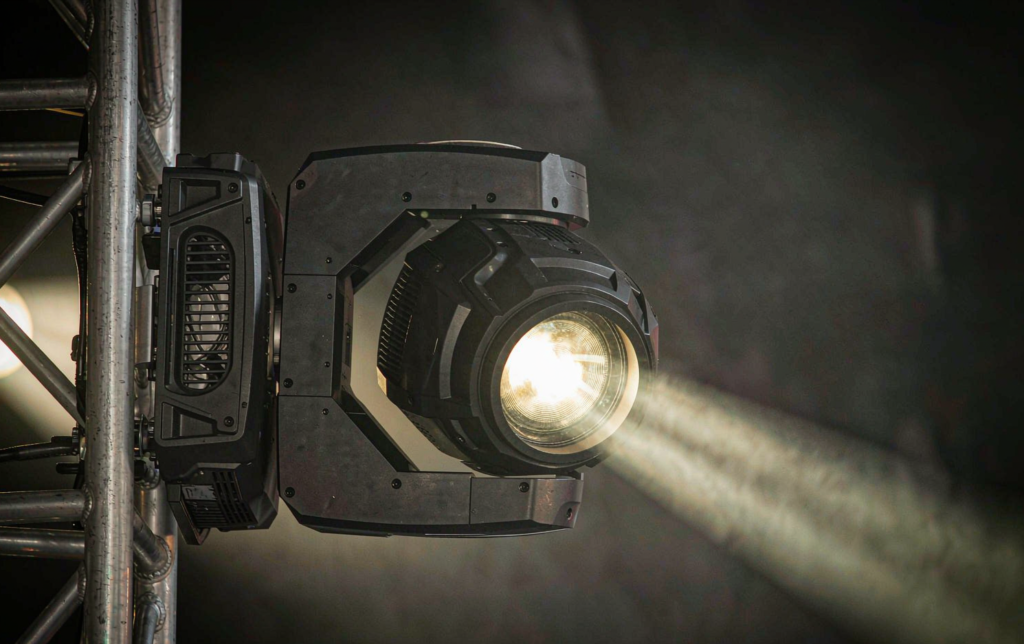
- Moving head — A yoke-mounted fixture that pans and tilts, projecting beams, spots, or washes you move live or via programming.
- Beam vs. Spot vs. Wash — Beam = a sharp, narrow shaft (the “finger” effect). Spot = a focused, gobo-capable image. Wash = a soft, wide pool of color.
- Gobo — A metal or glass template in the light that projects shapes, logos, or textures.
- DMX — Digital Multiplex, the universal control protocol. Fixtures “listen” to a console via DMX addresses (channels).
- Lux — Light intensity at a surface (lumens per square meter). More lux at distance = more visible punch.
- IP rating — Ingress Protection. IP20 = indoor; IP65 = dust-tight and rain-resistant outdoors.
- CRI / TLCI — Color Rendering / Television Lighting Consistency Index. 90+ means true skin tones and fabrics, not washed out.
- PWM / flicker — Pulse-width modulation frequency. Low PWM = visible camera flicker. Critical if you film or stream.
- Burn-in — Running a fixture for hours pre-shipping to catch early failures. (We do 48 hours per unit.)
Learn these and 80% of supplier confusion disappears.
3. The Main Types of Stage Lights (and What Each Does)
Understanding the types of stage lights is the foundation of every good purchase — here’s what each does and when to use it.
LED PAR / Parcan
The workhorse. A PAR floods a broad area with color for stage washes, wall uplighting, and backdrops. Cheap, rugged, and the safest first buy for a stage lighting kit for beginners; explore our LED PAR lights range.
LED Moving Head Lights
The star of the modern rig — a moving head pans and tilts to throw beams, spots, or washes anywhere. Sub-types:
- Spot — Sharpened images, gobos, logos.
- Beam — Narrow, piercing shafts for the “wow” effect.
- Wash — Soft color pools for ambient and dance-floor coverage.
- Profile — Framing shutters for crisp, shaped theater light.
- Bee Eye (19×15W/40W) — A lens array blending wash, beam, and pixel effects.
- 3-in-1 B/S/W — Beam, Spot, and Wash in one unit — ideal for small-club buyers wanting variety without three fixtures.
See our LED moving head lights lineup, including the 230W LED Spot & Beam Moving Head.
COB Lights
Chip-on-Board LEDs give a single, smooth, high-CRI source — ideal for front-of-house key light where faces must look natural on camera.
Laser Lights
Lasers draw sharp, saturated aerial beams and graphics. Stunning in haze, but regulated in some regions — check local rules first.
Follow Spots
A manually operated spotlight for a speaker, soloist, or bride. Essential for theater and awards; optional for a small club.
Strobe & Pixel Bar Lights
Pixel bars create chasing and edge-mapping effects; strobes add impact hits. Browse our strobe / pixel bar lights.
Fog & Haze Machines
Not a light — but you’ll see almost nothing without one. Haze suspends particles so beams show; fog makes ground clouds. See our fog and haze machines.
DMX Controllers
The brain. A console or interface sends DMX to address each fixture. More below in the DMX controller buying guide.
Lifting Beam Ring
A motorized hoist/truss ring for safely raising and lowering rigs — common in touring and large installs.
For a deeper dive into stage laser lights and specialty fixtures, see our per-model category pages.
4. LED vs. Conventional vs. Moving Head: Which Should You Buy?
The question we hear most: “LED vs moving head — which wins?” It’s not either/or; it’s a layered call on cost, maintenance, movement, and venue.
| Factor | Conventional (halogen/discharge) | LED static (PAR/COB) | LED moving head |
| Upfront cost | Low–mid | Low | Mid–high |
| Power draw | High | Low | Low–mid |
| Movement | None | None | Full pan/tilt |
| Maintenance | Bulbs burn out | Almost none | Low (fan/electronics) |
| Best for | Tight budgets, static washes | Washes, uplights, key light | Dynamic shows, clubs, events |
Our recommendation for first-timers: go LED across the board. Conventional bulbs eat power, fail mid-show, and cost more over three years. Use static PARs/COB for base wash and moving heads for energy — a small club rarely needs conventional anything.
Under $5k, lean on LED PARs plus one or two entry moving heads. At $10k+, a moving-head-forward rig looks 10 years newer.
5. Match the Rig to Your Venue
A stage lighting buying guide is useless without venue math. Here are concrete fixture-count starting points.
Small club / bar (capacity 100–250)
- 4–8 LED PARs for wall/backdrop wash
- 2–4 moving heads (beam or 3-in-1) for crowd energy
- 1 haze machine to make beams pop
- 1 DMX controller (192/384-channel)
- Optional: 2 pixel bars for the bar front
The classic best moving head light for small club recipe: movement leads, PARs fill gaps.
Wedding / banquet venue
- 8–12 battery or wired uplights around the room
- A dance-floor wash (4–6 PARs or a couple of wash moving heads)
- 2 moving heads for the first-dance moment
- 1 haze machine (low output, no triggering smoke alarms)
- A simple DMX controller or app-based system
A solid wedding package prioritizes flattering skin tones (high CRI) and easy teardown.
Theater / church
- Front fill: COB or profile spots with gobos
- Stage wash: PARs or wash moving heads
- 2–4 moving heads for special moments
- A robust DMX console with scene storage (volunteers need presets)
- Safety-rated rigging — non-negotiable with a permanent install
Rental company / mobile DJ
- A mixed inventory: PARs, beam and wash moving heads, lasers, haze
- Flight-cased, road-rugged fixtures
- Modular truss and quick-rig clamps
Want a free lighting configuration plan for your exact room? HELLO LIGHT’s engineers will sketch one up — just share your floor plan and ceiling height.
6. Budget Planning: How Much Does Stage Lighting Cost?
The question on every buyer’s lips: how much does stage lighting cost? Here are realistic 2026 ranges for complete rigs (fixtures only):
- Entry / beginner kit: 4,000–8,000 — a handful of PARs, 1–2 moving heads, a basic controller, small haze.
- Small club (~200 capacity): 6,000–15,000 — the full recipe above with better moving heads.
- Mid venues (300–800 capacity): 20,000–75,000 — multiple moving heads, lasers, pixel bars, a serious console, rigging.
Key Takeaway — The 20–30% Rule Add 20–30% on top of fixtures for what beginners forget: stands or truss, safety cables and clamps, DMX and power cable, a controller, spare fuses. A $6,000 list often becomes a $7,500 install. Budget the whole rig, not just the shiny parts.
Factory-direct vs. reseller: buying from a verified manufacturer like HELLO LIGHT removes one markup layer versus a local distributor, with direct customization answers. A trader quotes the same fixtures from the same factory — at a premium, with slower support.
7. Key Specifications That Actually Matter
Spec sheets bury useful numbers under marketing fluff. Here’s the 10-point checklist that matters:
- Lumens / lux at distance — Ask for lux at 5m, 10m, 20m. “10,000 lumens” at only 50 lux at 15m won’t reach your back wall.
- Beam angle / zoom range — 8°–40° zoom gives you both tight beams and wide washes from one fixture.
- CRI / TLCI — 90+ for anything filmed or for flattering faces.
- DMX channels — More channels = more control (color, gobo, pan, tilt, effects). Match to your console.
- IP rating — IP20 indoor; IP65+ for outdoor or bars with occasional spills.
- Fan noise — Under 40 dB for quiet venues (theater, weddings, churches).
- PWM / flicker-free — 1,000+ Hz (or “flicker-free”) for camera work.
- Build & housing — Metal housing with flame-retardant sections and anti-falling safety accessories outlast plastic.
- Power draw (W) — Needed for the load calc in section 9.
- Certifications — CE and RoHS for the EU; relevant marks for your market.
Ignore “super bright” claims without a lux number — that’s advertising, not engineering.
Key Takeaway — Specs to Ignore Vendors love huge LED counts and meaningless “brightness” bars. What you actually buy is reach (lux at distance), color quality (CRI), and control (DMX channels). If a quote can’t give you lux at 10 meters, walk away.
8. Control Systems & DMX: Don’t Skip the Console
This is the section most first-timers skip — and regret. A great fixture with no controller is a paperweight.
DMX channel logic: a 192-channel controller addresses ~12 fixtures at 16 channels each; 384 handles bigger rigs; 512 is the standard universe limit. Scene storage saves looks for one-button recall — essential with a volunteer operator.
Connectors: use 3-pin or 5-pin XLR DMX cable. Never substitute mic cable — it’s unrated for DMX and causes dropouts. Always terminate the last fixture with a 120-ohm DMX terminator to stop flickering.
For the full DMX controller buying guide, match your console’s channel count to total fixture channels, not fixture count. A small club with 6 moving heads (16 channels each) needs 96+ free channels — a 192 controller is the safe floor.
9. Safety, Rigging & Power Basics
Lighting is heavy, hot, and hung overhead. Get these wrong and you risk injury and insurance claims.
- Clamps & safety cables — Every hanging fixture needs a C-clamp and a secondary safety cable rated above its weight. No exceptions.
- Load ratings — Know your truss and ceiling limits; divide total weight by anchor points.
- Power math: Watts = Volts × Amps. A 230V/10A circuit gives 2,300W; the 80% rule caps safe load at 1,840W. Six 300W moving heads = 1,800W, leaving almost no margin. Plan circuits before buying.
- DMX terminator — Covered above; prevents signal bounce.
- Cable separation — Keep DMX and power runs apart.
A wedding planner we helped learned this the hard way: she budgeted $9,000 for a ballroom rig but forgot stands, clamps, and a second circuit. On setup day the single 15A circuit tripped three times at soundcheck. We rebalanced the load across two circuits and added the safety cables she hadn’t ordered. The reception went flawlessly — after a stressful, avoidable scramble. Budget the infrastructure.
10. How to Choose a Supplier: Factory vs. Trader
This section protects your money. Knowing how to choose a stage lighting manufacturer — and how to tell a real factory from a trader — separates a rig that lasts from one that vanishes with your deposit.
Manufacturer (factory): owns R&D, production, and QC; can show you the line and answer engineering questions. Trader: owns a catalog and a markup, sources from unknown factories, and vanishes at warranty time.
How to verify a real factory:
- Live production video — A walkthrough of the floor, not a brochure photo.
- Certifications — Valid CE marking, RoHS, and SASO documents for your target market, not screenshots.
- QC / burn-in — We run 48-hour per-unit burn-in so dead fixtures fail in our factory, not your venue.
- MOQ flexibility — Real factories like HELLO LIGHT offer NO MOQ, so you can start small.
- Support speed — A real factory answers technical questions in under 2 hours, 7×24.
- OEM / ODM — A genuine manufacturer builds under your brand (OEM) or co-develops (ODM).
Red flags: refuses video calls, can’t explain DMX addressing, pushes only “hot sellers,” or won’t name the certifying body. The PLASA industry body is a useful standards reference.
Key Takeaway — Supplier Shortlist Before paying a deposit, require three things: (1) live factory video, (2) verifiable CE/RoHS certs, and (3) a written response to a real technical question within 2 hours. If a supplier fails any one, they’re a trader pretending to be a factory.
11. HELLO LIGHT’s One-Stop Solution
We won’t hard-sell you. But it’s fair to show what a real factory partnership looks like — it answers the “who do I trust” question directly.
HELLO LIGHT (Guangzhou KALE Stage Lighting) has built stage lighting since 2017 — six production lines, 100+ material suppliers, and CE-certified fixtures with flame-retardant, anti-fall housings. Here’s what “one-stop” means for you:
- Free configuration plan — Send your floor plan; our engineers draw the rig and counts.
- Installation drawings — Truss, power, and DMX layouts for your local crew.
- On-site debugging — We support commissioning on larger installs.
- OEM / ODM — Your brand with our engineering, or co-developed products.
- After-sales — 7×24 support with <2hr response, plus annual overseas service visits.
- Global reach — Shipping to 200+ regions under clear Incoterms, with 48-hour per-unit QC burn-in.
We’d rather earn your trust with a drawing than a discount.
12. Common First-Time Buyer Mistakes
A church in Ohio mixed three brands of moving heads on one DMX line and hit address conflicts — half the rig fired wrong cues on Sunday, needing a tech visit. Avoid these traps:
- Effects before wash — Beams and lasers before basic wash coverage leave a room empty between songs.
- Ignoring ceiling height and power — Fixtures that can’t reach the floor, or circuits that trip (see section 9).
- No safety cable — The most dangerous and most common omission.
- Overcomplicating for volunteers — A 512-channel console scares off a volunteer operator. Start with scene storage.
- Cheapest-fixtures trap — Like Carlo’s $38 PARs, the lowest price often means no lux, no support, no warranty. A beginner kit should be value, not rock-bottom.
13. FAQ
How much does stage lighting cost? Complete rigs run 4k–8k (entry), 6k–15k (small club), and 20k–75k (mid venues), plus 20–30% for infrastructure. See section 6.
How many lights do I need? It depends on venue and ceiling — a 200-capacity club starts at 4–8 PARs + 2–4 moving heads + haze + a controller. See section 5.
Do I need a DMX controller? Yes, with more than two fixtures or programmed looks. Even a 192-channel controller unlocks scenes volunteers can run. See section 8.
LED vs moving head — which should I buy? Both, in layers: LED PARs/COB for wash, moving heads for energy and movement. Conventional bulbs rarely worth it today. See section 4.
Can I mix brands? Technically yes, if DMX addresses don’t conflict and the console supports them. But mixing raises setup risk (see the Ohio church story); a matched rig is simpler.
How do I verify a real factory in China? Request live production video, verifiable CE/RoHS certs, and a fast technical answer. Our how to tell a real factory from a trader piece has the full checklist.
14. Conclusion & Next Steps
Choosing your first rig doesn’t have to feel like defusing a bomb. Start with your venue, set a realistic budget (fixtures plus 20–30% infrastructure), learn the specs that matter, and buy from a verified factory — not a trader with a flashy logo.
To recap: match fixtures to the room, layer wash under movement, never skip the controller or safety cable, and verify your supplier with live video and real certs. That’s the whole stage lighting buying guide in five sentences.
Ready to stop guessing? HELLO LIGHT will draw you a free lighting configuration plan and quote for your exact room — no obligation, no MOQ, answers in under 2 hours. Send your floor plan and ceiling height; our engineers will hand you a rig that works on opening night.
Your room deserves better than 20 dim nightlights. Let’s build the real thing.