Most buyers start by comparing spec sheets. That is the wrong first step. What decides whether a show opens on time is not how bright one fixture looks on paper, but whether the company behind it can design the rig, build it consistently, document it for a local crew, and answer the phone when something fails at 9 p.m. on a Friday.
HELLO LIGHT is the trademark of Guangzhou KALE Stage Lighting Equipment Co., Ltd. Our website describes the business in one line: “One-stop professional solutions for stage lighting problems.” Sales, drawing design, installation commissioning and after-sale service sit inside one manufacturing company, rather than across a chain of resellers. That structure is the subject of this guide.
This page is written for the people who actually specify and buy: distributors, importers, rental houses, AV contractors, system integrators and venue owners. It covers what “one-stop” should mean in practice, the fixture range and services behind it, how to match equipment to a room, how to verify a supplier, and the exact path from a first enquiry to a delivered, working rig.
A note on accuracy. This article is based on information published on hello-lite.com and on our official product pages. Model names and the numbers inside them (380W, 19x40W and so on) appear only to describe the range we sell. Optical, electrical, channel, weight and IP figures are not restated here: use the specification sheet on the relevant product page and the formal certificates for your market. If a figure is not on the official page, we do not print it in a guide.
Key Takeaways
- A genuine one-stop stage lighting solutions partner owns design, production, QC and support, so accountability has one address.
- HELLO LIGHT (Guangzhou KALE Stage Lighting), founded 2017 in Huadu District, Guangzhou, is a manufacturing enterprise integrating R&D, production, sales and service.
- The range covers LED moving heads, PAR and COB wash, lasers, follow spots, strobes and pixel bars, fog and haze machines, and DMX controllers, with OEM and ODM support.
- Published services include a configuration plan, installation drawing design, on-site commissioning, 7×24 response with technical answers inside 2 hours, 48-hour per-unit testing, and NO MOQ.
- Verify any partner with a 5-step checklist before paying a deposit. A supplier that cannot draw your room cannot deliver your rig.
1. What “One-Stop” Actually Means When You Buy Stage Lighting
1.1 The supplier model matters more than the spec sheet
A factory and a trading company can produce almost identical quotations: the same categories, similar wording, the same stock photography. The difference shows up after the deposit.
Factory-direct means R&D, production, QC and service close the loop inside one organisation. You can ask how a DMX channel map is structured, or how much thermal headroom the power stage carries at 40°C ambient, and get an answer from an engineer. You can ask for a light plot for your room. When a fixture fails, there is one responsible party. A trading desk owns a catalogue and a margin; technical questions get forwarded, and the factory behind a second order may not be the factory behind the first. Batch consistency is impossible to promise under that model.
Our About page describes the company as a manufacturer “integrating independent research and development, production, sales, and service of professional stage lighting equipment”, and lists a one-stop service built around a configuration plan, installation drawing design and on-site lighting debugging. Both claims are testable. Ask for a drawing of your own venue. It tells you more than ten pages of brochure copy.
1.2 The three costs a one-stop partner removes
The cost of choosing badly rarely appears in the unit price. It shows up later, in three places:
- Communication cost. A DMX address conflict that bounces between a salesperson and an unseen factory can burn days. Our published mechanism is a 7×24 hotline with technical questions answered inside 2 hours. Closing a problem in hours rather than weeks is the practical value.
- Consistency cost. Rental houses and multi-site operators reorder the same SKU months apart. Owned production lines and a fixed QC protocol are what make the second shipment behave like the first.
- After-sales cost. Fixtures hang above people. When one fails, the question is not “who ships a replacement” but “who has the part, who can be on site, and who will train our operator”. Spare parts, annual overseas customer visits and commissioning support determine whether downtime is measured in hours or weeks.
Put plainly, what you are buying is a system that works in your room. The fixtures are the physical part of it.
2. Who Is HELLO LIGHT (Guangzhou KALE Stage Lighting)
2.1 Brand, legal entity and naming
Getting the names right prevents errors in contracts and shipping documents. HELLO LIGHT is the brand and trademark used on the website. Guangzhou KALE Stage Lighting Equipment Co., Ltd. is the legal entity. Product model codes begin with KL-, and official correspondence comes from addresses ending in @kalelight.com. All three point to the same company; the site footer states that HELLO LIGHT is a trademark of Guangzhou KALE Stage Lighting Equipment Co., Ltd.
The company was founded in 2017 in Baiyun District, Guangzhou. Its stated principles are “Integrity, Quality, and Innovation”, with “high quality, high efficiency, high experience” as the product inspection standard. The brand concept is a one-stop solution for stage lighting, covering sales, drawing design and after-sale service.
2.2 R&D, production, QC and export
A company that calls itself a factory needs to be able to walk through four stages and show evidence for each:
| Stage | Published on our website | What it means for a buyer |
| R&D | Independent research and development across multiple product series | Specifications can be discussed against a project, not just picked from a stock list |
| Production | Six complete production lines, large finished-goods inventory, immediate supply from more than 100 material suppliers | Lead times and batch consistency are more controllable |
| Quality control | Professional inspectors run 48-hour tests on each product as required by the specification; every ex-factory unit carries an inspection mark | Early failures surface in our factory, not during your show |
| Export | Cooperative relationships with transport companies in more than 200 regions | Goods can be delivered to the receiving address in most destinations |
Safety by design is listed separately on our About page: the full line uses steady-current and constant-voltage power supplies, which are less prone to component damage in harsh environments, and housings are made from flame-retardant or metal materials with safety anti-falling accessories. For equipment rigged above an audience, these details deserve attention before any discussion of output.
2.3 Who we work with
Our site states that KALE series products are exported to the Americas, Africa, Southeast Asia, the Middle East, Australia and other regions, and are used in large-scale concerts, outdoor performances, weddings, DISCO, nightclubs, theatres and karaoke venues. The customer testimonials from more than 50 countries, including Kenya, Botswana, Cambodia and Vietnam. The company also organises teams to visit customers abroad to understand real requirements and solve after-sales problems, described on the site as “door-to-door service”.
That profile points to one audience: B2B buyers who need a complete delivery and long-term support, not someone buying a single fixture.
3. The Product Range: From Beam Moving Heads to DMX Consoles
Our About page lists the main series as LED moving head lights, COB lights, laser lights, follow spot lights, strobe lights, fog machines and DMX controller series. The homepage “hot-selling products” area shows a number of specific models. Grouped by function:
Specification note. Model names and the numbers within them are taken from our official pages and only describe range composition. For optical, electrical, channel, dimensions, weight and IP figures, use the specification sheet on the relevant product page. Nothing below should be read as a parameter commitment.
3.1 LED moving heads
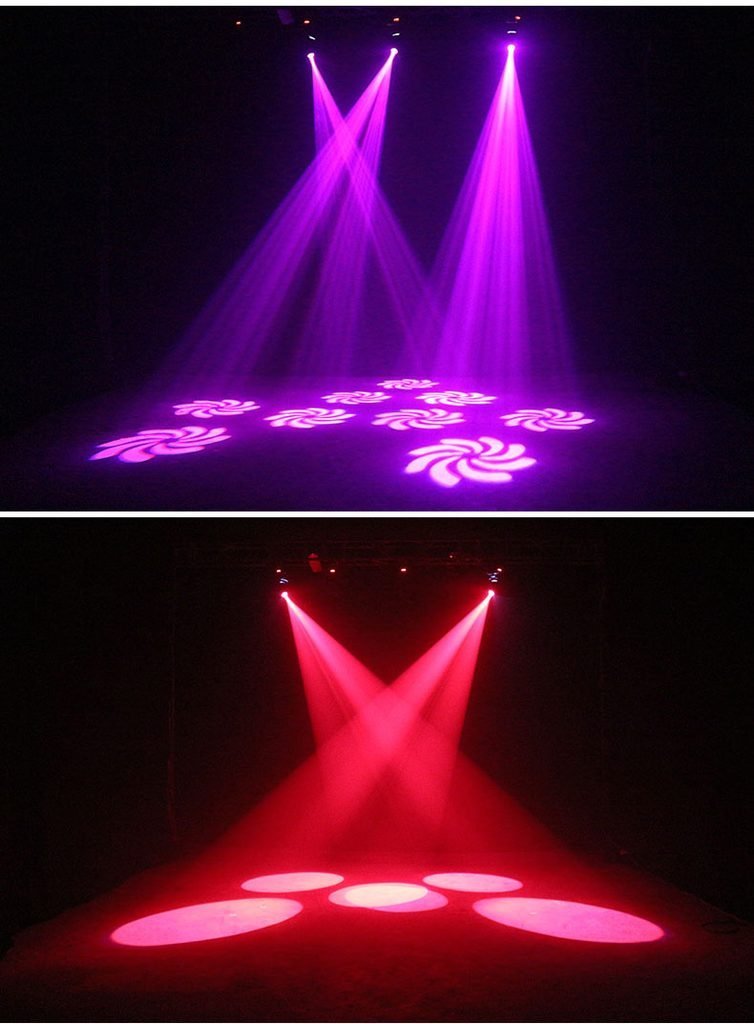
Moving heads carry the dynamic content and usually take the largest share of the budget. The published range covers four broad shapes:
- Beam models such as
KL-MB230,KL-MB260,KL-MB380 IP(waterproof) andKL-MB480, for sharp aerial shafts and mid-air effects. - B/S/W 3-in-1 and Beam/Spot/Wash/Profile models such as
KL-BSW280,KL-BSW350,KL-BSW380II,KL-BSWP700LandKL-BSWP1000L. One unit covers beam, pattern and wash, which suits rooms that need variety from fewer hanging positions. - Bee Eye, pixel and matrix models such as
KL-BE1940 IP 19x40Wwaterproof Bee Eye,KL-ML7B60,KL-ML6P60and theHL-ML25Mmatrix light, for individual pixel control, bee-eye and mirror-ball effects. - Spot and Beam hybrids such as the
HL-ML230BS230W LED Spot & Beam Moving Head Light.
3.2 Wash and face light: PAR, COB and matrix
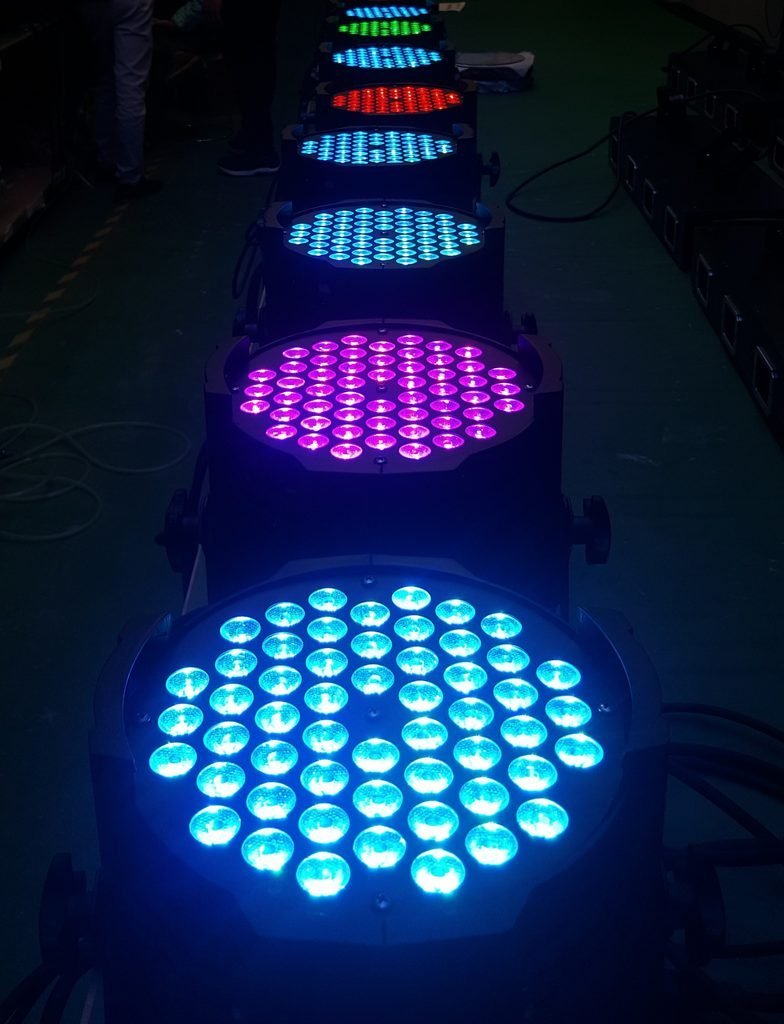
Every effect needs a clean base layer underneath it. LED PAR / Parcan units flood a broad area with colour for stage washes, wall uplighting and backdrops. COB fixtures give a single, smooth, high-CRI source for front-of-house key light where faces must look natural on camera. Matrix and pixel fixtures sit between the two, providing both wash and effect.
The most common first-purchase mistake is not “not enough effects”. It is a missing base wash, which leaves beams hanging in the air with nothing to land on. If you are new to the vocabulary, our stage lighting buying guide explains PAR, moving head, beam/spot/wash, gobo, DMX and IP ratings in plain language.
3.3 Effects and atmosphere
- Laser lights draw sharp aerial lines and graphics. Check local regulations before specifying them, as laser use is controlled in some markets.
- Strobe and pixel bar lights add impact hits, chasing and edge mapping for clubs and DJ work.
- Fog and haze machines do not emit light, but they decide whether beams are visible at all. Without haze, much of a moving head’s output is invisible.
3.4 Control, follow spots and weatherproof fixtures
DMX controllers are the brain of the rig: they handle addressing, scene storage and live playback. Size the console by the total channel count of all fixtures, not by the number of fixtures, and terminate the last unit correctly to avoid flicker. Follow spots cover speakers, soloists or a bride where a human operator tracks the subject. Waterproof (IP) series fixtures serve outdoor shows and venues where spills or weather are a factor; verify that connectors and power interfaces carry the same protection as the housing.
3.5 Category quick reference
| Category | Role in the rig | What to check | Site entry |
| LED moving heads | Beam, spot, wash, patterns | Zoom range, channel modes, noise, IP rating | LED moving head lights |
| LED PAR / COB | Base wash, face light, uplighting | Colour rendering, mixing uniformity, dimming curve | LED PAR lights |
| Laser lights | Aerial lines and graphics | Local rules, safety interlocks | Stage laser lights |
| Strobe / pixel bars | Impact, chasing, pixel mapping | Duty cycle, addressable control | Strobe and pixel bar lights |
| Follow spots | Manual subject tracking | Operating method, usable throw | Follow spot lights |
| Fog / haze machines | Making beams visible | Alarm compatibility, output control | Fog and haze machines |
| DMX controllers | System control and scenes | Channel capacity, scene storage, operator skill | All products |
4. Match the Rig to the Venue
There is no universally best rig, only one that fits the room. The table below gives selection logic rather than a fixed shopping list. Final quantities and models should come from a configuration plan based on room dimensions, ceiling height, available power, camera requirements and budget.
| Application | What matters most | Categories to prioritise |
| Concerts and large tours | Long throw, fast pan/tilt recovery, mechanical rigidity | High-output beam moving heads, Bee Eye, pixel bars, haze, a large console |
| Theatre and TV studios | Colour accuracy, low noise, flicker-free output | COB face light, profile / 3-in-1 moving heads, PAR wash, console with scene storage |
| Clubs, DISCO and KTV | Energy, continuous duty cycles, heat tolerance | Beam moving heads, pixel bars, strobes, lasers, fog and haze |
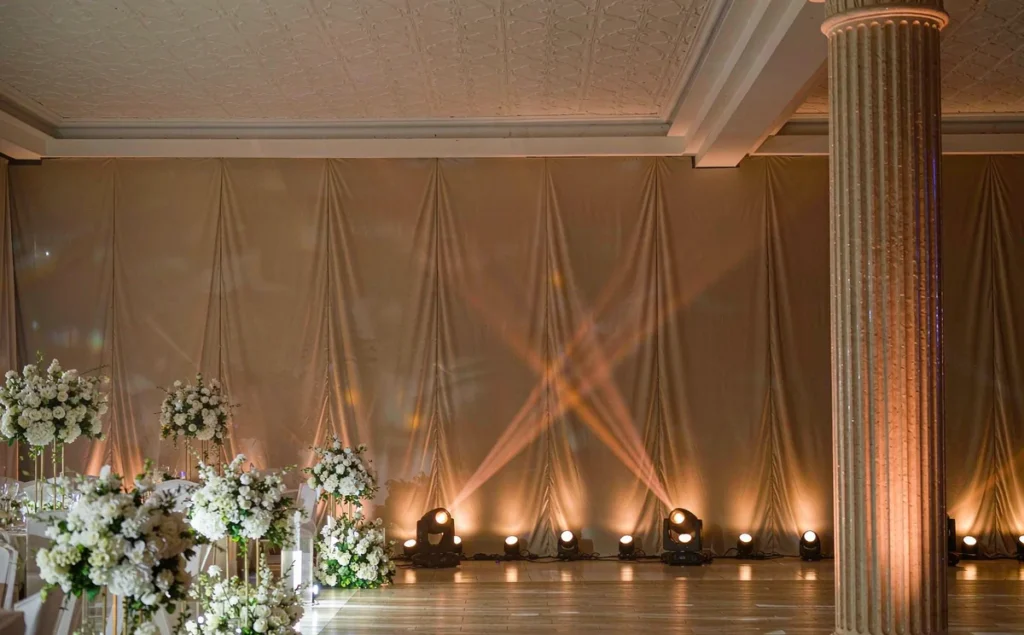
| Weddings and corporate events | Flattering skin tones, fast setup, no dedicated LD | PAR or battery uplights, a few moving heads, follow spots, simple controller, low-output haze |
| Outdoor and open-air | Dust and water protection, corrosion resistance | Waterproof (IP) moving heads and Bee Eye, protected connectors |
| Small venues and rental starters | One fixture doing several jobs, easy transport and operation | 3-in-1 moving heads, PARs, a compact console, a basic haze machine |
Three reminders that apply to every row:
- Build the wash before the effects. Beams and lasers only read properly over an existing layer of coverage.
- Budget the infrastructure separately. Truss or stands, clamps and safety cables, DMX and power cabling, the console, terminators and spare parts all sit outside the fixture line. Our buying guide covers this as a separate planning step.
- Ask the factory to draw it. We publish a configuration plan and installation drawing design as part of the one-stop service. Sending a floor plan and ceiling height gets you a count you can actually build from, instead of a guess.
For a documented example of that process in a real 60 m² room, see our small stage lighting design case study, which includes the light plot and fixture list.
5. Beyond Fixtures: The Services Behind a One-Stop Solution
Product catalogues look similar across suppliers. Service structure is where “one-stop” separates from “we ship boxes”. The following capabilities are published on our About page; confirm the exact scope and deliverables for your project in writing.
5.1 Configuration plan, drawings and on-site commissioning
The one-stop service is described on our site as providing the best stage lighting configuration plan according to customer conditions, installation drawing design and on-site lighting debugging. The company also states it can provide stage lighting design, allocation projects, installation testing, technical solutions and sound-and-light project work.
5.2 OEM and ODM
Our About page states that OEM orders are accepted, with production cycle and customisation type set according to customer requirements, and that support such as LOGO design and manuals can be provided. ODM is also within scope. For distributors, importers and chains building their own branded line, this removes the need to hire optical and mechanical engineers in-house.
If you want a structured view of how OEM differs from ODM and which model fits a distributor, rental house or integrator, our stage lighting manufacturer guide covers both models side by side.
5.3 QC, safety by design and certifications
Published QC practice: professional inspectors run 48-hour tests on each product as required by the specification, and every ex-factory unit carries an inspection mark. Safety design uses steady-current and constant-voltage power supplies with flame-retardant or metal housings and safety anti-falling accessories. Product pages carry CE compliance statements, for example on the HL-ML25M matrix light page.
For RoHS, SASO and other market-specific approvals, rely on the certificate documents and the formal quotation, not on a guide. Requirements differ by destination, and the entity named on a certificate must match the entity on your contract. Confirm the final list with your import agent before shipment.
5.4 Response, spare parts and global delivery
- Instant response: a 7×24 sales and service hotline, with technical questions answered and resolved within 2 hours.
- Quick shipping: large finished-goods inventory, six complete production lines and supply from more than 100 material suppliers.
- Overseas visits: every year the company organises teams or individuals to visit new and existing customers, understand their needs and solve problems on site.
- Global shipping: transport partnerships in more than 200 regions.
6. How to Verify a Stage Lighting Partner: A 5-Step Checklist
Use this on any supplier, including us. It turns “are they a real factory” into a set of questions you can actually ask.
| Step | What to ask for | How a factory responds |
| 1. Production evidence | A live video walkthrough of the floor, lines and assembly benches, not a photo deck | Connects immediately and names the processes on camera |
| 2. Engineering depth | “What is the thermal headroom at 40°C ambient?” “How is the DMX channel map structured?” | An engineer answers in numbers and logic, rather than redirecting to sales |
| 3. QC and certificates | Burn-in duration, inspection marking, and certificates naming the contracting entity | Document names match the company you are paying |
| 4. Design capability | A configuration list, light plot and installation drawing for your floor plan | Produces a plan based on your dimensions, not a generic catalogue |
| 5. After-sales reality | Where spares ship from, response times, commissioning and console training | Terms are specific enough to write into a contract |
7. Frequently Asked Questions
What does “one-stop stage lighting solutions” actually include? It means one supplier covers the fixture range, the configuration plan and drawings, commissioning, control setup and after-sales support. Instead of coordinating a factory, a designer and a local installer separately, accountability sits with a single manufacturer.
What equipment is in a complete stage lighting rig? Typically a base wash layer (PAR or COB), dynamic fixtures (moving heads, lasers, strobes, pixel bars), atmosphere (fog or haze), a DMX controller, and the infrastructure: truss or stands, clamps, safety cables, cabling and terminators. Exact composition depends on the room. We do not publish a universal package price here; request a configuration plan.
Do I need a DMX controller? Yes, once you have more than two fixtures or any programmed looks. Size the console by the total channel count across all fixtures, not by fixture count, and use proper DMX cable with termination at the end of the line to prevent flicker and dropouts.
Can you design the rig if we have no lighting designer? That is a published part of the one-stop service: a configuration plan, installation drawing design and on-site lighting debugging. Send a floor plan, ceiling height, intended use and available power. For venues run by volunteers, ask for stored scenes that can be recalled with one button.
Do you offer OEM or ODM? Yes. OEM orders are accepted, with production cycle and customisation type set to customer requirements, and LOGO design and manual support available. ODM is also in scope. It suits distributors and chains building a branded range.
How do I get a configuration plan and a quote? Submit the enquiry form on the website with your venue dimensions, ceiling height, application, target budget and destination. Sales quotes after receiving the purchase information; once both sides confirm the details, samples can be sent, and a final order follows sample approval. Our site notes a reply within 1 working day, so watch for mail from an @kalelight.com address.
Where should I verify product specifications? On the specification sheet of the relevant official product page and in the formal certificates. This guide deliberately omits unverified lumen, lux, channel, weight and IP figures. Ask your sales contact for the official spec sheet for the exact model before you sign anything.
8. From First Visit to Delivery: A Clear Path to a Quote
Breaking the purchase into steps is faster than comparing catalogues indefinitely. The flow below follows the process published on our site.
- Build the vocabulary. Start with the stage lighting buying guide so PAR, moving head, DMX, IP rating and CRI mean something before you ask for prices.
- See the range. Open all products, then narrow to two or three category pages using the venue table in section 4.
- Write down your conditions. Floor plan, ceiling height, supply capacity, audience size, primary use (concert, wedding, club, rental), whether the show is filmed, and the budget band.
- Request the plan. Submit the enquiry form with those conditions and ask for a configuration plan and installation drawings. The quality of the response is itself a supplier audit.
- Confirm samples and details. After both sides agree the transaction terms, samples are sent; a formal order follows sample approval. OEM and ODM details are fixed at this stage.
- Production, QC and delivery. Units are produced, tested under the published QC process, then shipped by the agreed method. Later technical questions go through the 7×24 channel.
A practical next step. If you already know your room dimensions, there is no need to read every product page first. Send the floor plan and ceiling height to our engineering team and ask for a configuration plan and quote for your project. It is faster than assembling a spec sheet yourself, and it surfaces the infrastructure items that buyers most often forget.
9. Conclusion
Choosing one-stop stage lighting solutions is really choosing who carries responsibility for the whole system. Specifications set the ceiling of what a rig can do; delivery capability sets the floor. On show night, it is the floor that gets tested.
The order of judgement is simple. Confirm the supplier can join R&D, production, QC and after-sales into one accountable company. Check that the product range covers every category your room needs. Ask for a plan and drawings for your actual venue. Then put response times, spares, certificates and delivery terms in writing. HELLO LIGHT (Guangzhou KALE Stage Lighting) has worked to a one-stop positioning since 2017, exports to multiple regions, and lowers the barrier to a first order with NO MOQ and 7×24 technical response. Every one of those claims can be checked with the 5-step list above.